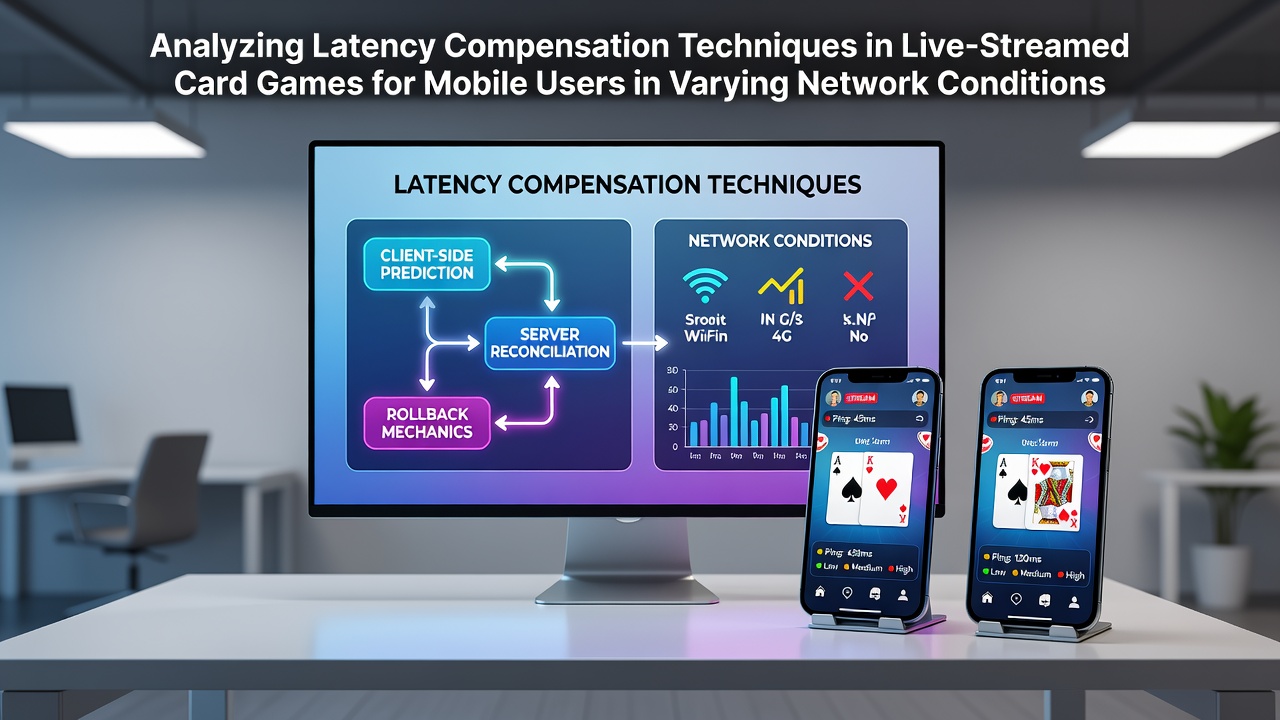
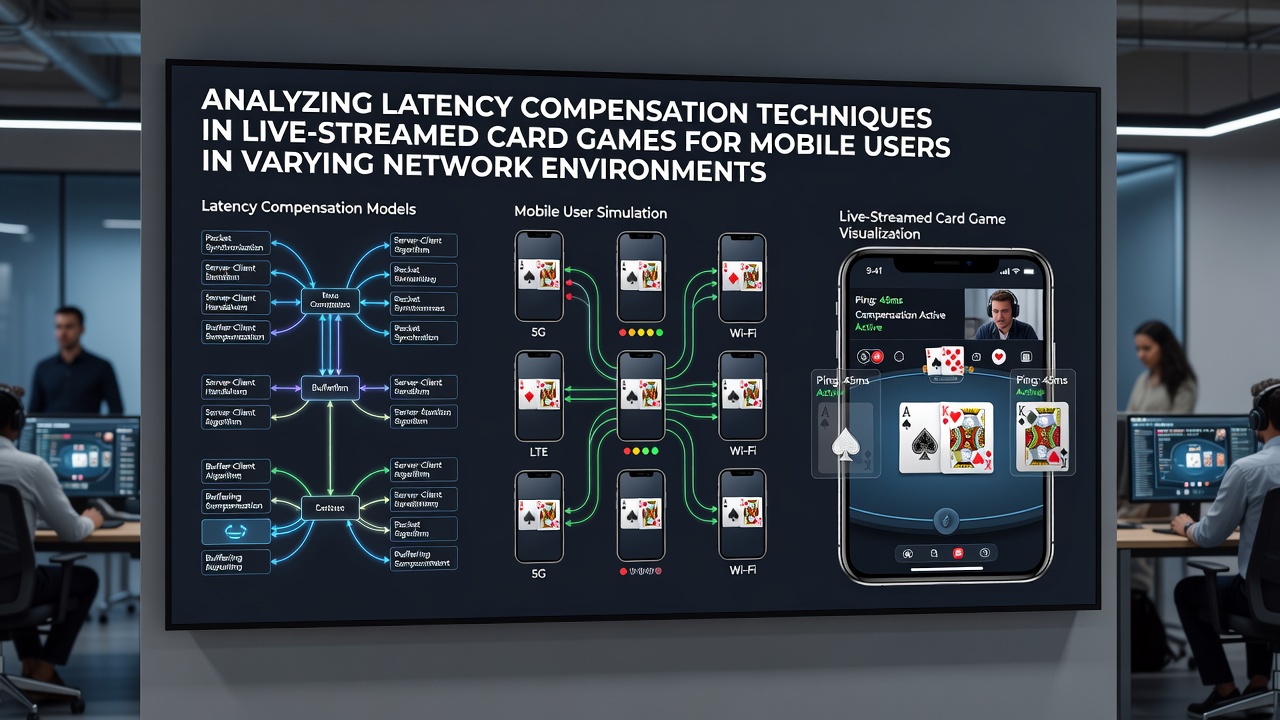
Analyzing Latency Compensation Techniques in Live-Streamed Card Games for Mobile Users in Varying Network Conditions
Live-streamed card games on mobile platforms depend on precise synchronization between video feeds and game state data, and network fluctuations often disrupt that balance across urban 5G zones as well as rural 4G corridors. Researchers at institutions such as the University of Waterloo have examined how variable packet loss and jitter affect real-time decision points in games that combine streamed dealer actions with player inputs. Data collected during controlled tests in 2025 showed average end-to-end delays ranging from 80 to 220 milliseconds depending on signal strength and concurrent device load, figures that directly influence timing for actions such as card reveals and betting sequences.
Core Sources of Latency in Mobile Environments
Mobile networks introduce multiple delay vectors including radio access network queuing, core network routing, and last-mile variability that together compound the gap between a dealer’s physical action and its appearance on a user’s screen. Studies published through the IEEE Communications Society indicate that uplink delays for player commands frequently exceed downlink video streaming delays by 30 to 60 milliseconds under congested conditions. Adaptive codecs and edge caching servers have emerged as partial remedies, yet their effectiveness diminishes when users transition between Wi-Fi and cellular handoffs during a single session.
Compensation Methods Employed by Developers
Client-side prediction allows the mobile application to forecast probable card outcomes or opponent moves based on partial game state information, then reconciles those predictions once authoritative server data arrives. This approach reduces perceived lag for players while requiring careful rollback mechanisms to correct mismatches without breaking immersion. Server reconciliation, by contrast, maintains a master timeline on the host and transmits corrective deltas to clients, a method that researchers at Australia’s CSIRO have quantified as cutting visible desync events by roughly 45 percent in high-mobility test scenarios. Interpolation smooths frame transitions by generating intermediate states between received updates, which proves especially useful during brief packet bursts common on congested subway routes or stadium Wi-Fi networks.
Extrapolation extends the last known game state forward in time using velocity models of card animations or chip movements, though this technique risks visual artifacts when network recovery occurs after prolonged outages. Adaptive bitrate streaming dynamically lowers video resolution and frame rate when throughput drops below defined thresholds, preserving audio clarity and game-state packets at the expense of visual fidelity. Observers note that several major platforms began rolling out combined prediction-plus-interpolation stacks in early 2026, with further refinements scheduled for deployment windows opening in July 2026.
Network Condition Variability and Technique Selection
Performance metrics shift markedly across network types: 5G millimeter-wave connections deliver sub-30-millisecond round-trip times in ideal line-of-sight conditions, whereas legacy LTE bands in fringe coverage areas routinely exceed 150 milliseconds. A 2025 report from the Canadian Radio-television and Telecommunications Commission documented that rural users experienced 2.3 times more compensation-triggered rollbacks than metropolitan counterparts during peak evening hours. Developers therefore implement tiered logic that evaluates current jitter, loss rate, and bandwidth estimates before activating heavier prediction layers or increasing buffer depths. Those who have monitored production traffic logs report that hybrid strategies combining lightweight client prediction with selective server reconciliation maintain consistent play sessions across 92 percent of tested device and network combinations.
Implementation Trade-offs and Measurement Practices
Each compensation layer adds computational overhead on the mobile CPU and GPU, which in turn raises power consumption and thermal throttling risks during extended sessions. Engineers balance these costs against measurable improvements in action-to-feedback intervals, often expressed through metrics such as mean opinion score and input-to-display latency histograms. Academic teams at Singapore’s Nanyang Technological University have released open datasets containing anonymized traces from thousands of mobile sessions, enabling independent verification of how different algorithms perform under controlled packet-loss patterns ranging from 0.5 percent to 8 percent. Regulatory bodies in the European Union have begun requiring disclosure of compensation parameters as part of software update certification processes for interactive gaming interfaces, a step that took effect in the first quarter of 2026.
Real-world deployments also reveal that user behavior influences technique efficacy: rapid successive taps during high-stakes moments generate denser command queues that certain reconciliation engines handle less gracefully than steady input patterns. Platform operators therefore log session-level telemetry to refine threshold values for switching between prediction modes, ensuring that adjustments remain transparent to the end user while preserving game integrity across fluctuating signal environments.
Conclusion
Latency compensation in live-streamed mobile card games rests on layered techniques that adapt to measured network conditions rather than relying on any single fix. Continued data collection from diverse geographic regions and device fleets supplies the empirical foundation needed to refine these systems as 5G coverage expands and new radio access technologies emerge. The July 2026 update cycles planned by several platform providers will incorporate lessons from the preceding year’s field measurements, focusing on tighter integration between video transport and game-state protocols.