
The Influence of Behavioral Tracking Technologies on Personalized Gaming Experiences in Digital Environments
Behavioral tracking technologies collect extensive data on player actions, preferences, and interaction patterns within digital games and virtual spaces, then feed that information into algorithms designed to adjust content delivery on the fly. Developers integrate telemetry tools that log everything from session duration and movement paths to decision-making sequences, allowing systems to generate profiles that evolve with each play session. These profiles support personalization features such as dynamic difficulty scaling, tailored quest recommendations, and adaptive narrative branches that respond directly to observed behavior rather than static presets.
Data Collection Mechanisms in Modern Gaming Platforms
Modern platforms rely on a combination of client-side sensors, server-side logging, and machine learning models to process behavioral signals at scale. Heatmap generation tracks where players linger or avoid certain areas, while clickstream analysis reveals navigation habits across menus and in-game interfaces. Researchers at institutions including the University of California, Santa Cruz have documented how these layered data streams enable real-time segmentation of user groups based on playstyle clusters, which in turn informs targeted content updates delivered through over-the-air patches.
Integration with device hardware extends tracking beyond software events alone. Accelerometer readings from mobile devices capture physical gestures during touch-based gameplay, and eye-tracking capabilities in certain VR headsets record visual attention hotspots during immersive sessions. Such multi-modal inputs create richer behavioral datasets that algorithms use to predict future engagement levels and preemptively adjust reward schedules or environmental elements to maintain flow states.
Personalization Algorithms and Their Operational Logic
Personalization engines apply reinforcement learning techniques to refine recommendations after each interaction cycle. When a player consistently favors exploration over combat, the system increases the frequency of discovery-focused side activities while reducing exposure to high-intensity encounters. Similar logic governs cosmetic item suggestions and social feature prompts, matching offerings to historical spending patterns and group affiliation data.
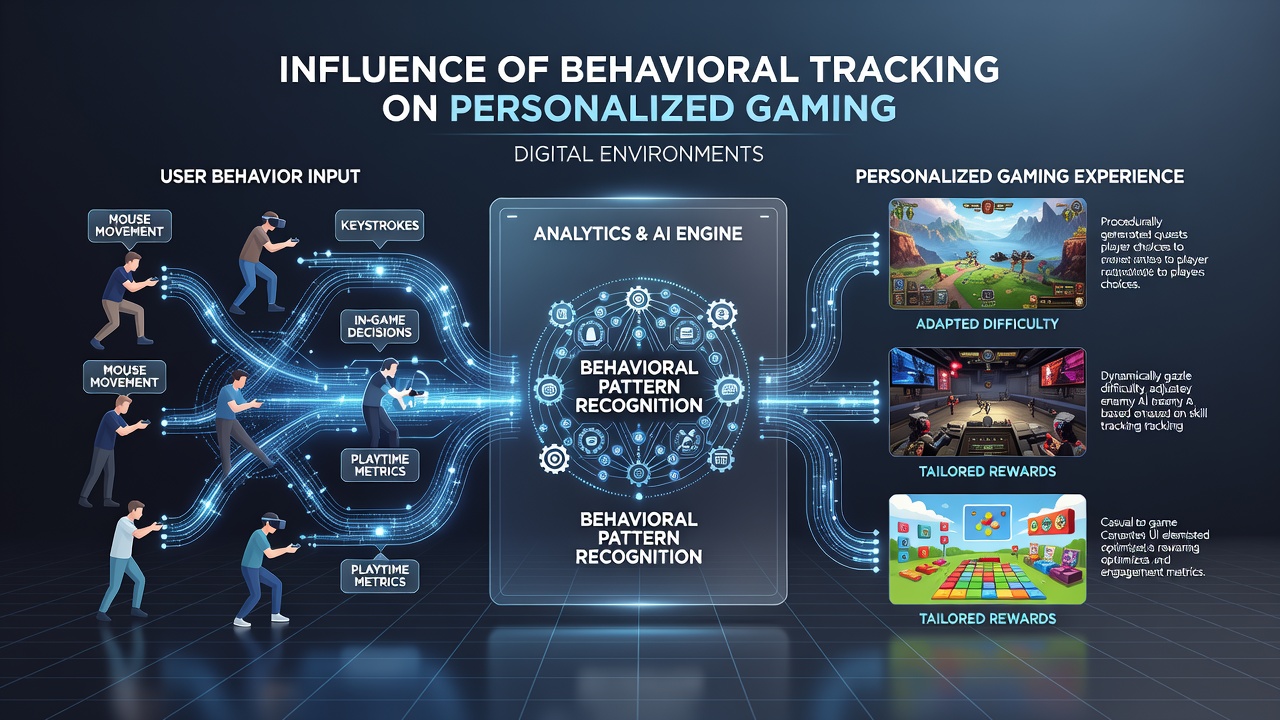
Cross-game data sharing within publisher ecosystems further amplifies these effects. Information gathered from one title can influence onboarding sequences in another, creating continuity across a studio's portfolio. Figures released by the Entertainment Software Association indicate that titles employing advanced behavioral personalization retain active users for longer average periods compared with non-adaptive counterparts, though exact retention differentials vary by genre and platform.
Regulatory Developments and Industry Standards as of August 2026
Regulatory bodies have begun addressing transparency requirements around behavioral tracking practices. In August 2026 the European Commission updated its guidelines on digital services, mandating clearer disclosure of data usage in entertainment applications across member states. Parallel moves by the Australian Communications and Media Authority introduced reporting obligations for platforms operating within that jurisdiction, focusing on consent mechanisms and data retention limits. These frameworks require developers to provide users with accessible summaries of tracked metrics and options to limit certain collection categories without losing core functionality.
Industry groups such as the Interactive Games and Entertainment Association have issued voluntary best-practice documents that align with emerging rules, emphasizing audit trails for algorithmic decision-making. Compliance teams now routinely test personalization systems against these standards before major releases, documenting how behavioral signals translate into content variations to satisfy oversight reviews.
Technical Infrastructure Supporting Real-Time Adaptation
Cloud-based analytics pipelines handle the volume and velocity of incoming behavioral data, routing processed insights to edge servers that deliver localized adjustments with minimal latency. Containerized microservices isolate different tracking modules, enabling independent scaling during peak usage windows such as new content launches. Database architectures incorporate time-series storage optimized for querying sequential player actions, which supports both immediate personalization and longer-term trend analysis used in content planning cycles.
Security protocols encrypt behavioral datasets during transmission and at rest, while access controls restrict internal visibility to aggregated or anonymized views for most team members. These measures address requirements from multiple regulatory regimes simultaneously, allowing global releases to proceed under unified compliance architectures.
Conclusion
Behavioral tracking technologies continue to shape how digital environments respond to individual players through continuous data ingestion and algorithmic refinement. As regulatory landscapes evolve and technical capabilities expand, the mechanisms linking observed actions to personalized outputs remain central to contemporary game design and platform operation across regions.