
Tracing Third-Party Lab Validation Workflows for Adaptive RNG Sequences in Multi-Jurisdictional Slot Networks
Adaptive RNG sequences in slot networks adjust their output patterns based on real-time inputs such as wager size or session length, and third-party laboratories follow structured workflows to confirm these sequences meet fairness standards across borders. Labs begin by receiving source code and documentation from developers, then isolate the core algorithm to map how it responds to varying triggers while maintaining statistical integrity over millions of simulated spins. This initial mapping phase uses specialized tools that log every state transition, and analysts compare results against predefined entropy thresholds established by multiple regulatory bodies.
Core Components of Validation Workflows
Validation proceeds through sequential stages that include static code review, dynamic execution testing, and long-term distribution analysis, with each stage building on the last to capture how adaptive elements interact with base randomness. Researchers run controlled simulations that introduce player-like variables at irregular intervals, and they track whether the RNG maintains uniform probability across all possible outcomes even as it shifts modes. Data from these runs feeds into statistical suites that apply chi-square tests, serial correlation checks, and runs tests, while any deviation triggers additional rounds of scrutiny until the sequence stabilizes within accepted parameters.
Multi-jurisdictional requirements add layers because operators must satisfy differing certification criteria in places like Nevada, Ontario, and Victoria, Australia, and labs maintain separate compliance matrices for each market. Analysts cross-reference the adaptive logic against jurisdiction-specific rules on maximum deviation limits and minimum return-to-player percentages, then document how the sequence behaves under each set of constraints without altering the underlying code. This documentation travels with the certified build so regulators can verify consistency during audits.
Handling Adaptive Elements Across Borders
Adaptive sequences often incorporate feedback loops that alter seed selection or cycle length based on external signals, and labs replicate these loops in isolated environments that mirror live network conditions. They introduce latency variations and concurrent session loads to observe whether the RNG preserves randomness when multiple adaptive triggers fire simultaneously, and any correlation that emerges leads to code revisions before retesting begins. Observers note that such iterative cycles can extend validation timelines by several weeks when networks span three or more regulatory zones.
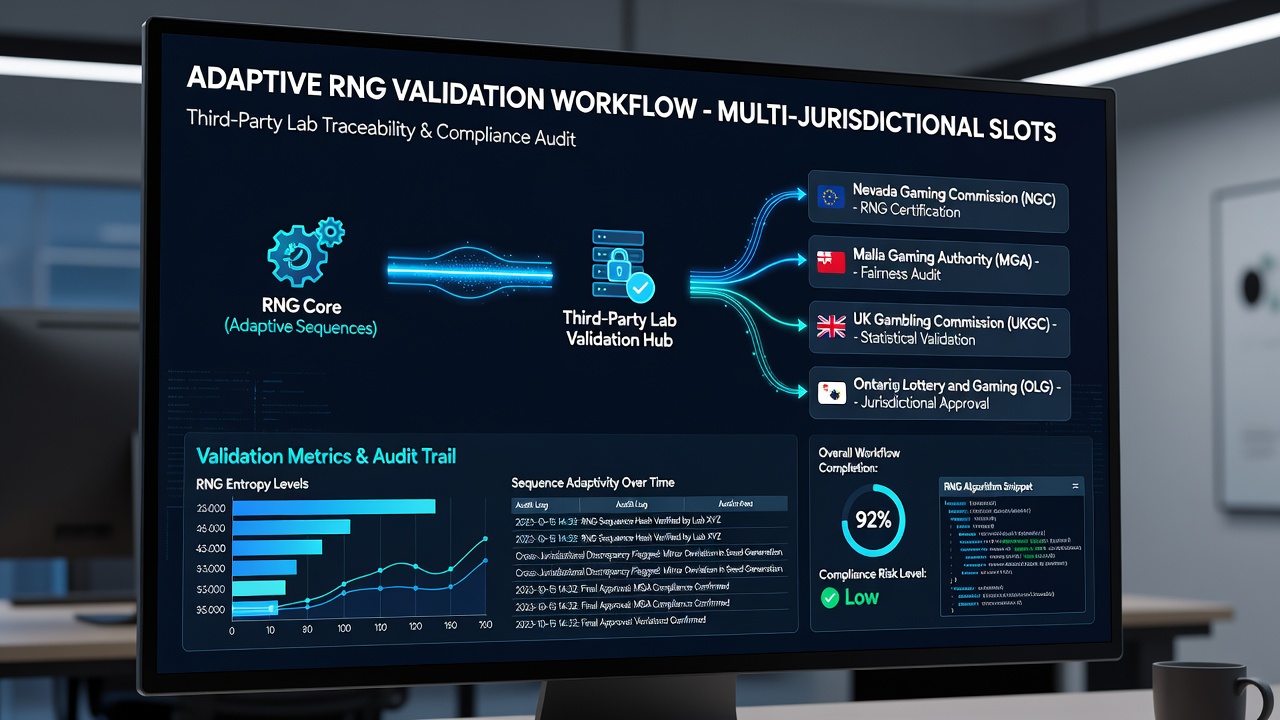
July 2026 brought updated interoperability guidelines from the Nevada Gaming Control Board that require labs to submit unified test reports covering adaptive behavior in both land-based and remote deployments. These reports must include timestamped logs showing how sequences responded to simulated regulatory stress tests, and the new format allows regulators in different regions to compare results more efficiently. Labs have adjusted their reporting templates accordingly, incorporating standardized fields for entropy measurements taken at each adaptive threshold.
Integration of Real-Time Monitoring Tools
Modern workflows incorporate continuous monitoring hooks that operators install after initial certification, and third-party labs periodically sample live data feeds to confirm ongoing compliance. These samples undergo the same statistical batteries used during initial validation, and discrepancies prompt immediate investigation that may involve rolling back adaptive parameters until the sequence returns to certified behavior. Data from the Victorian Commission for Gambling and Liquor Regulation shows that such post-certification sampling caught three adaptive drift incidents in linked slot networks during the first half of 2026.
Case examples illustrate the process in action, with one network operator submitting an adaptive RNG that adjusted volatility after extended play sessions. The assigned lab mapped every volatility shift, ran over 500 million test cycles, and confirmed that return percentages remained within tolerance across all targeted jurisdictions before issuing the final report. Another project involved reconciling conflicting RNG seed rules between North American and European markets, and the lab developed a conditional branching module that satisfied both sets of requirements without compromising randomness.
Conclusion
Tracing these workflows reveals a methodical sequence of reviews, simulations, and cross-jurisdictional checks that keep adaptive RNG sequences aligned with fairness mandates as slot networks expand. Laboratories document every step so regulators can reconstruct the validation path, and the resulting certifications support secure deployment across multiple markets. Continued refinement of testing protocols in response to regulatory updates ensures that adaptive mechanisms remain transparent and verifiable long after initial approval.